Prove endpoint resilience before threats disrupt the business.
XDRShield is a unified EDR and XDR security platform for MSPs, IT teams, and SOC teams that need clear endpoint visibility, governed investigation, and controlled response when operations cannot afford uncertainty.
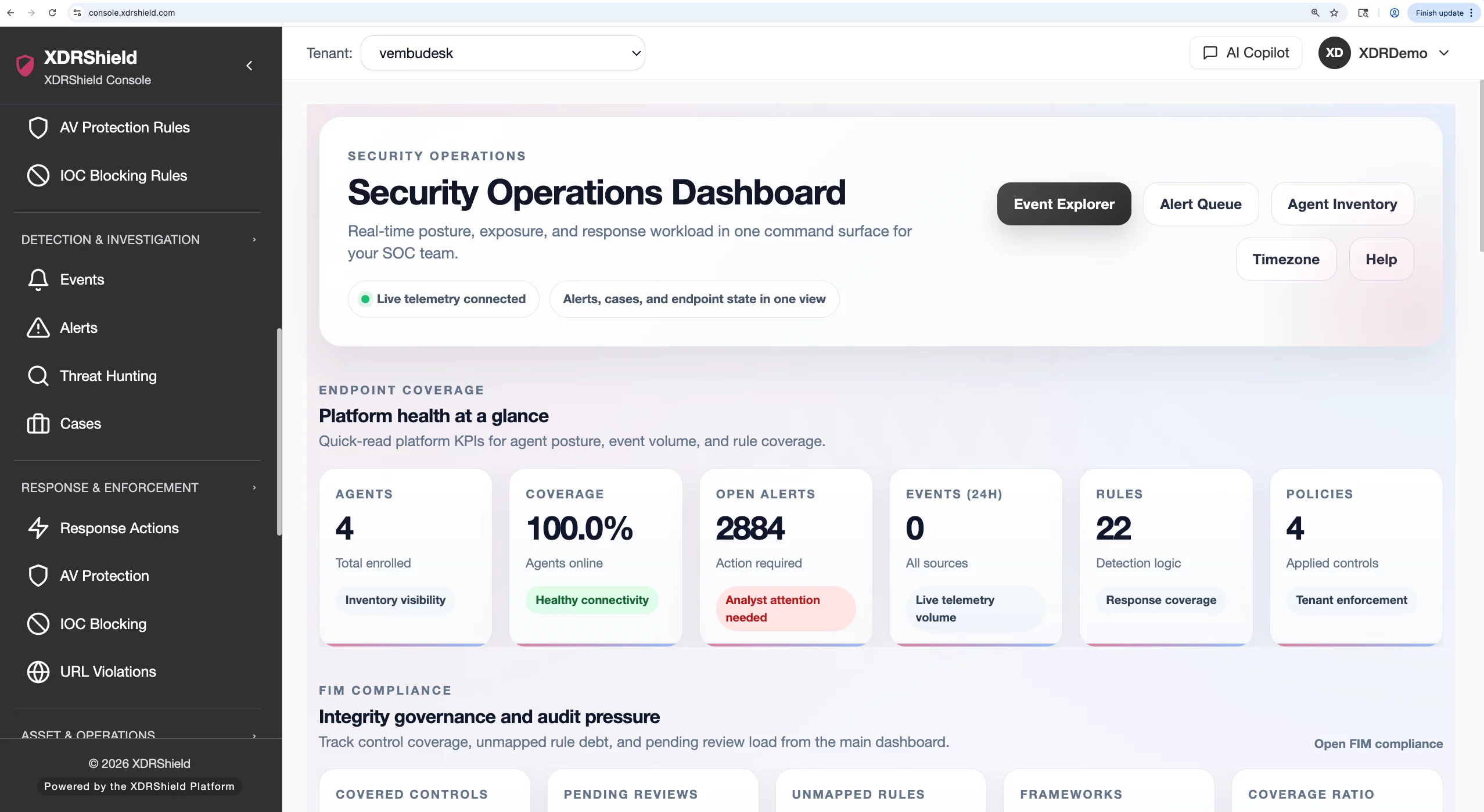
Live posture view
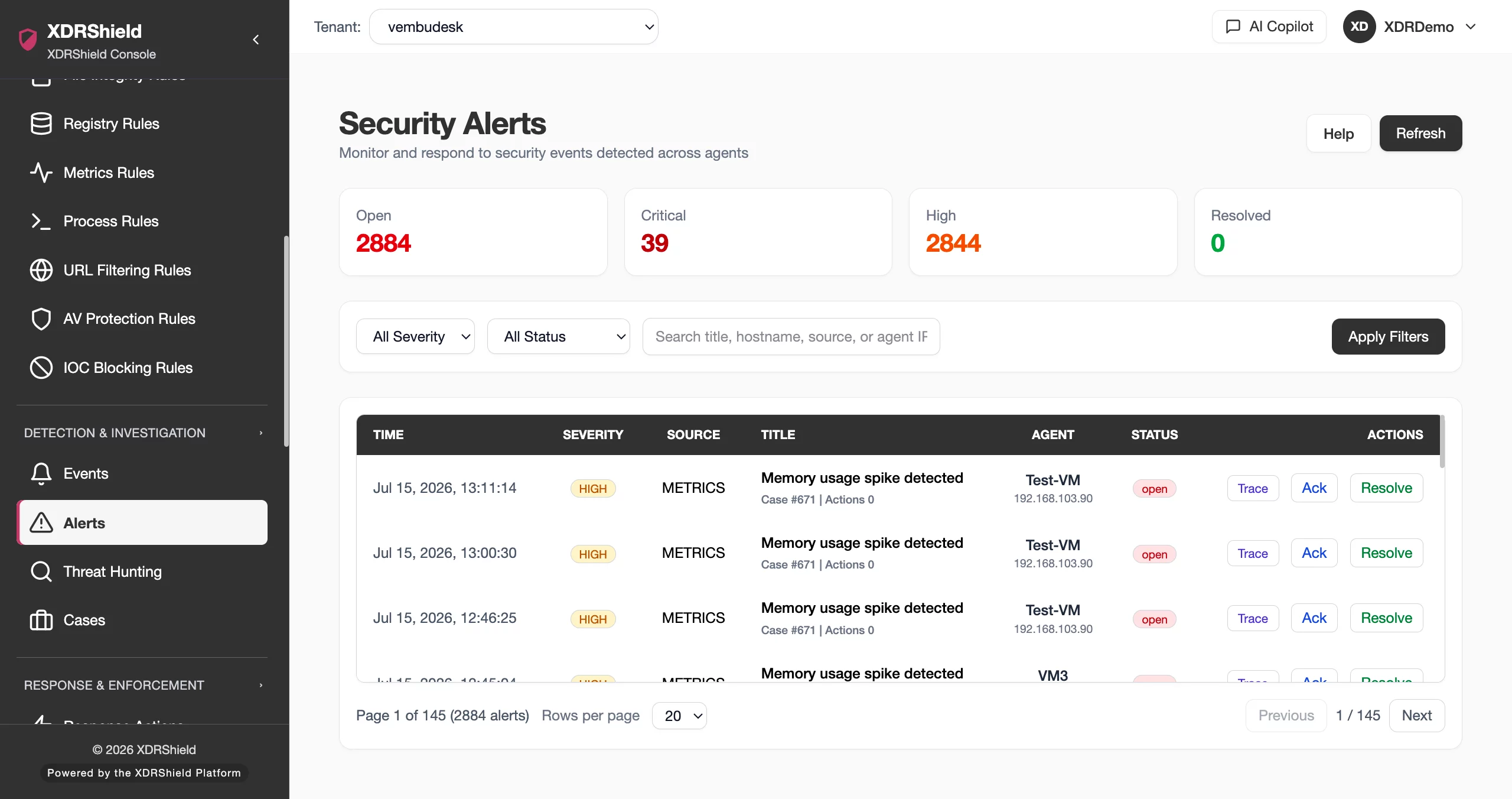
Open alerts requiring triage
Agents reporting
Detection rules
Applied policies
02:10 Suspicious endpoint activity appears.
02:24 Case evidence, scope, and response path are visible.
Built for teams accountable for cyber resilience.
Whether you are running a managed security practice, an in-house IT team, or overseeing a lean SMB environment, XDRShield gives you the tools to stay ahead of modern threats without enterprise-level complexity.
For MSPs managing client resilience
Deliver security to every client from one console with multi-tenant management, separated environments, centralized alerts, and repeatable workflows clients can trust.
- Multi-tenant management with complete client isolation
- Centralized alert dashboard across managed environments
- Per-tenant policies for consistent service delivery
- Operational control without switching tools
For IT teams protecting business endpoints
Bring endpoint telemetry, investigations, response actions, and activity records into one working view so teams can move quickly without losing control.
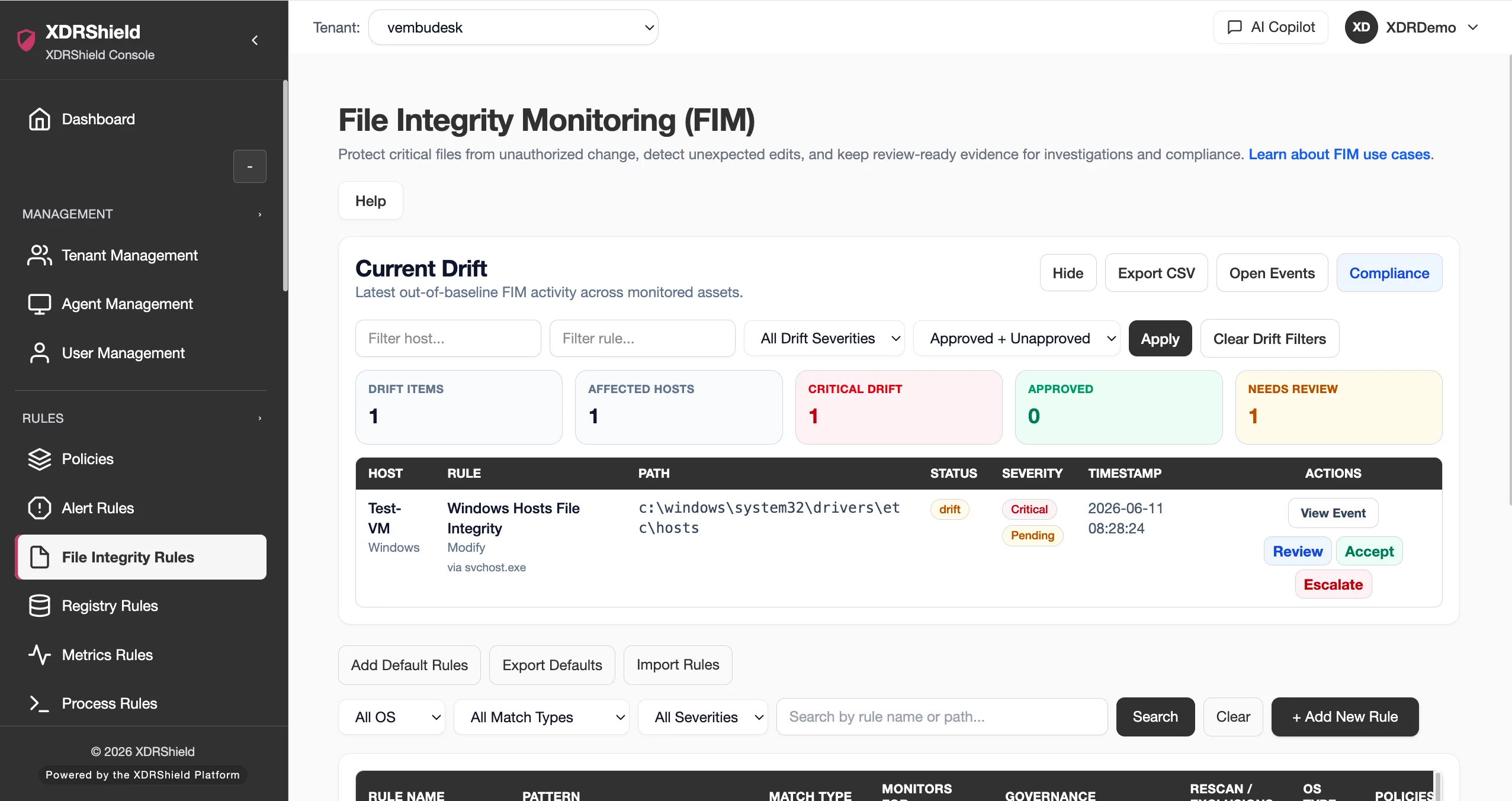
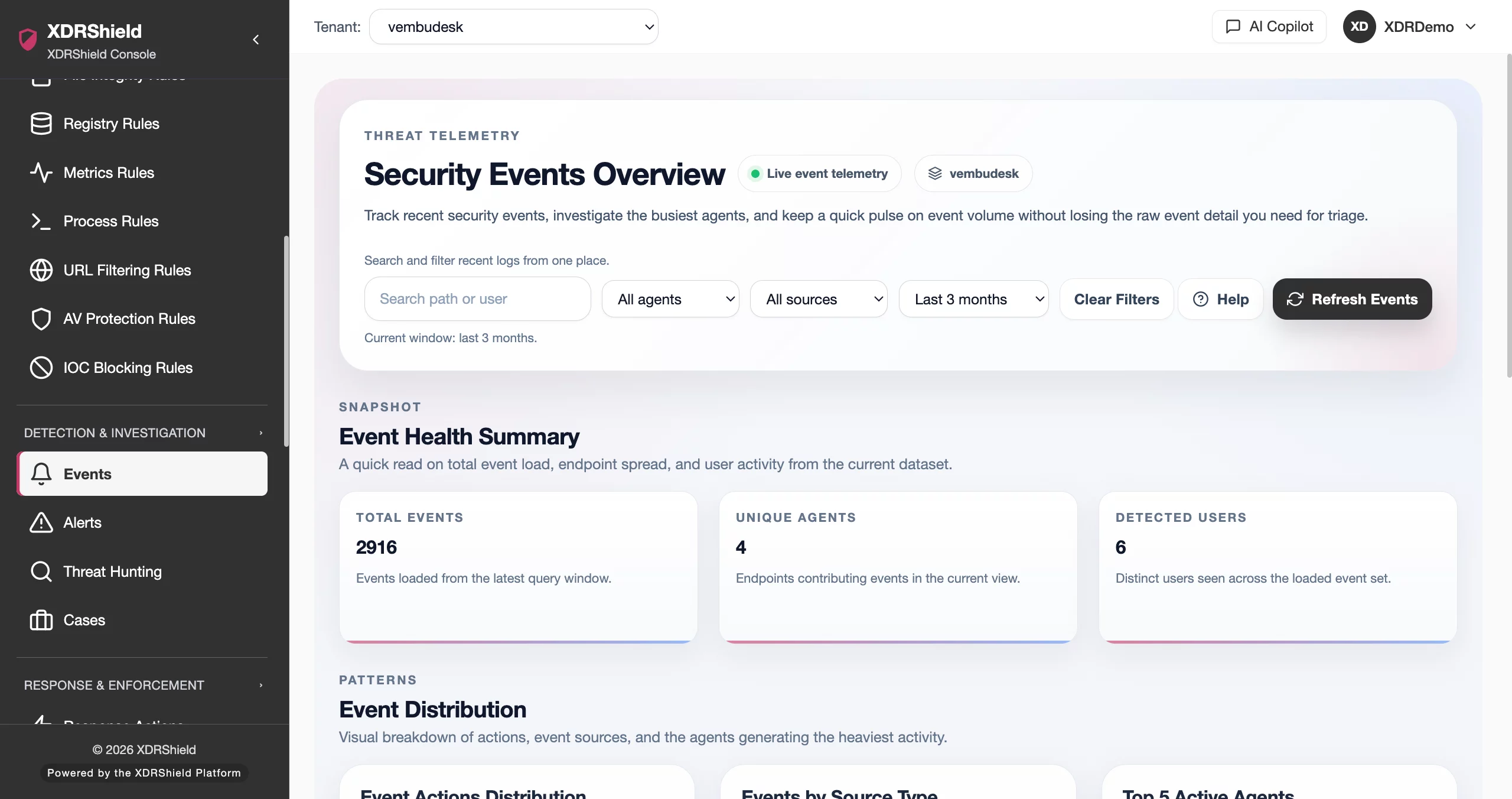
- Real-time endpoint telemetry across files, processes, registry, and network activity
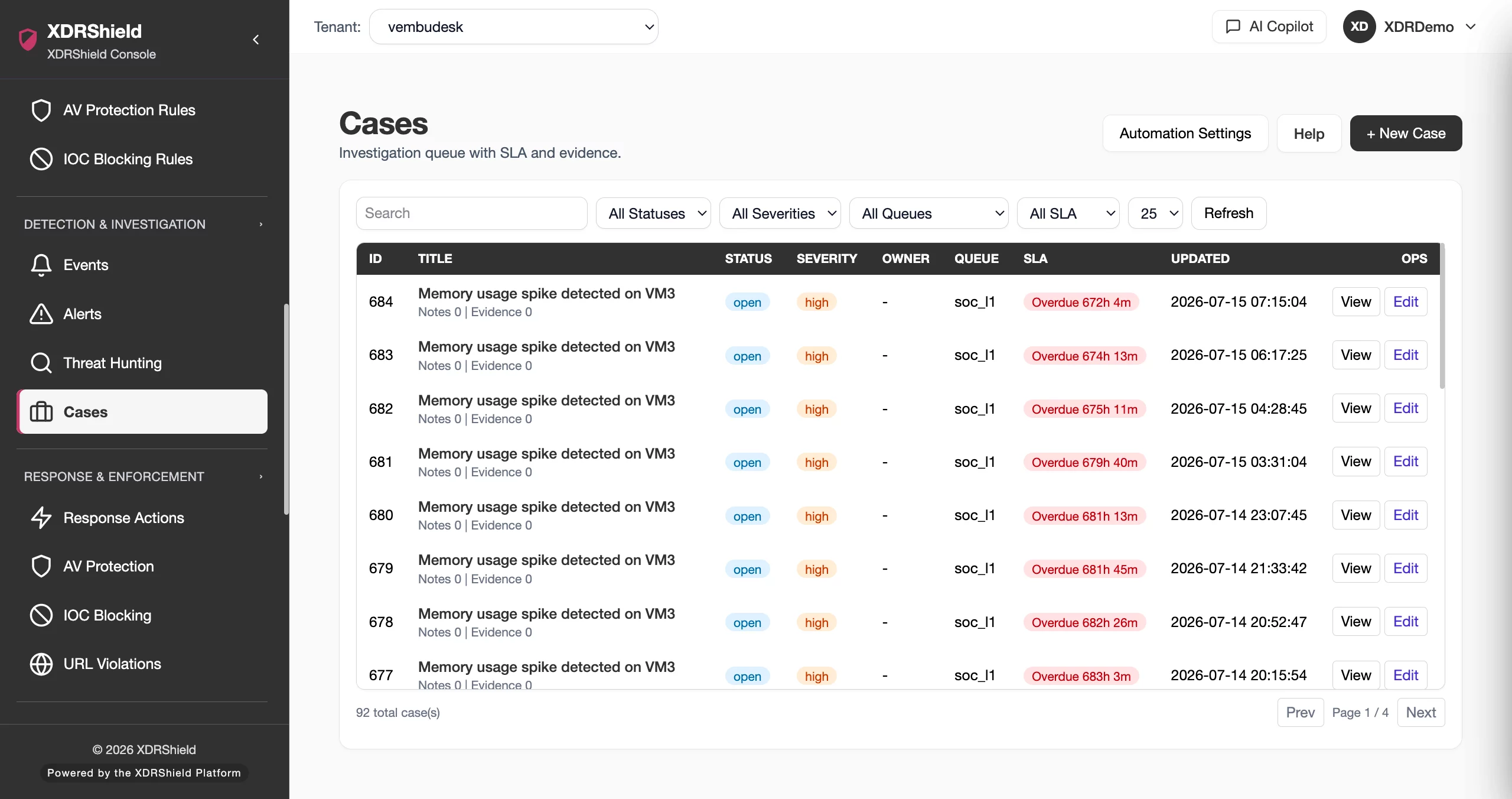
- Structured cases with timelines, notes, and evidence
- Role-based access control with approval workflows
- Complete activity logs for every endpoint action
For SOC teams needing governed response
Reduce alert sprawl with structured investigations, customizable detections, playbooks, and a clear record of what happened and what was done.
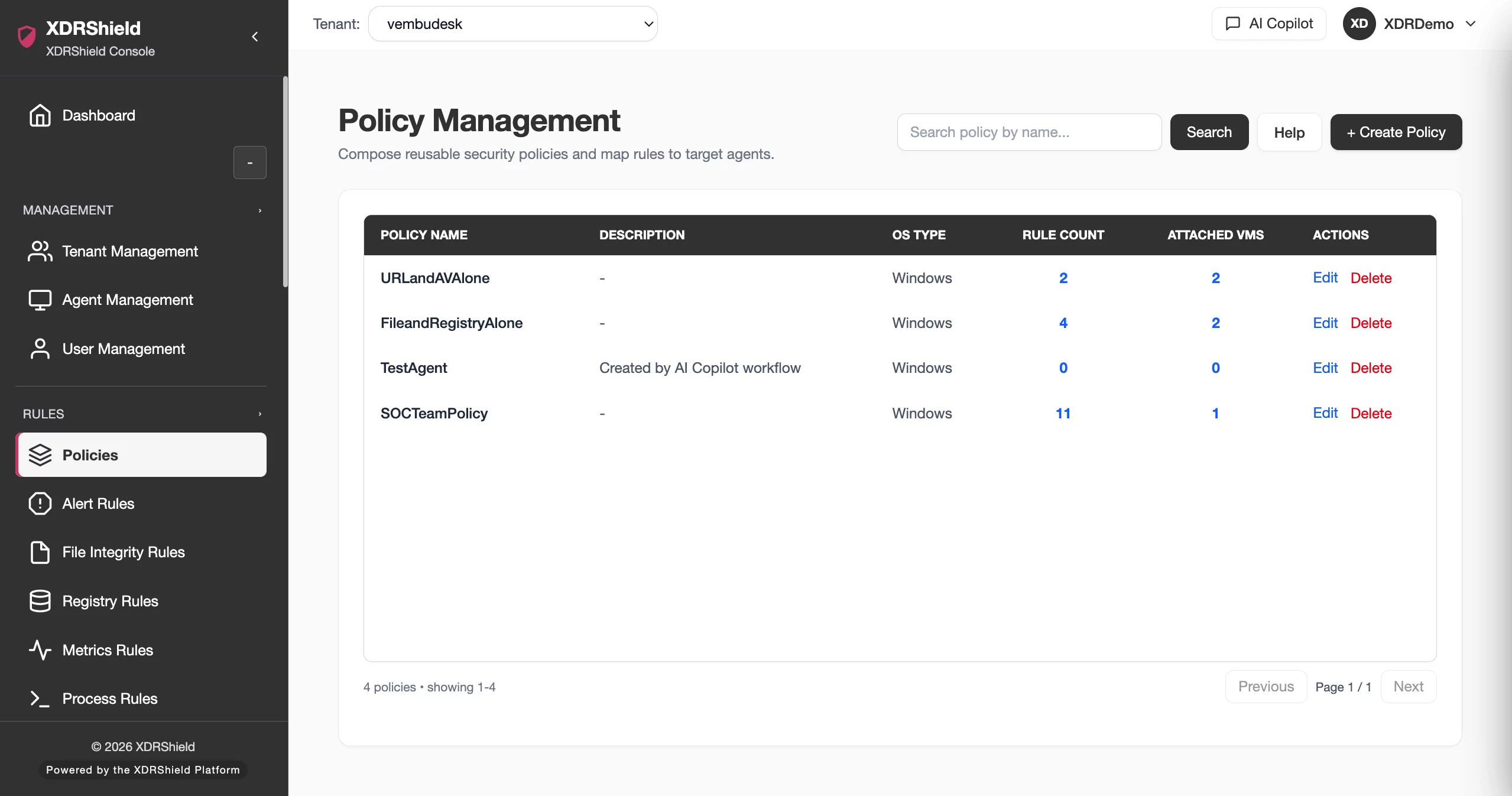
- Easy agent deployment with centralized policy management
- Alert triage and case management without a dedicated SOC
- Pre-built playbooks for safe response actions
- Complete activity logging
Measurable proof of security readiness.
XDRShield keeps operational proof visible across the areas security teams care about most: detection, investigation, response, visibility, operations, and trust.
Six pillars for resilient security operations.
XDRShield brings every layer of security operations into a single, coherent platform. Every pillar works together so teams do not have to switch tools, lose context, or leave gaps in visibility.
Threat Detection
Continuously monitor endpoint activity across files, processes, registry changes, network behavior, and system metrics. Customizable rules and policies help tune alerts to your environment.
Structured Investigation
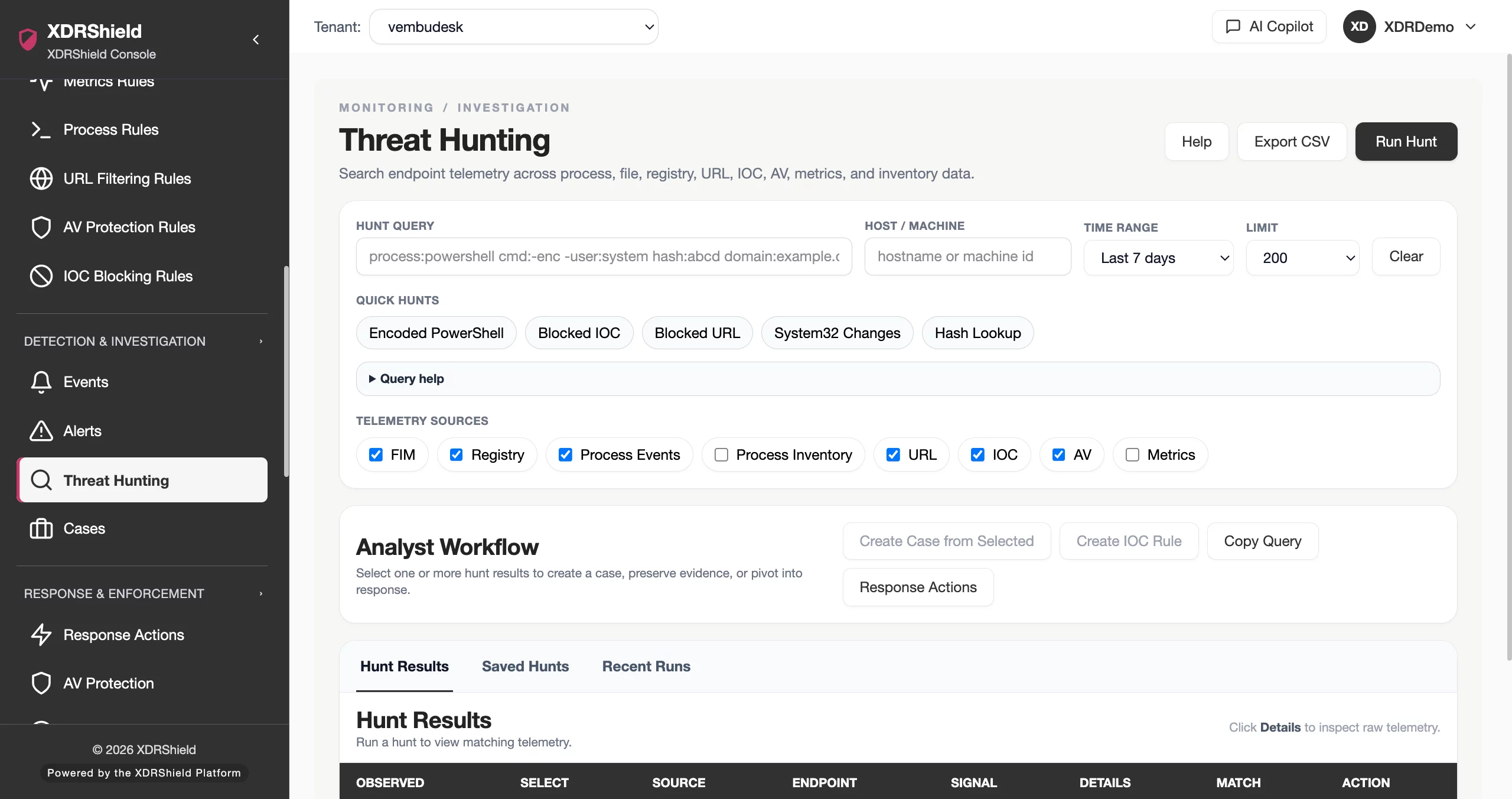
Turn raw alerts into answers with structured cases, event timelines, analyst notes, evidence attachments, and correlated activity across endpoints.
Controlled Response
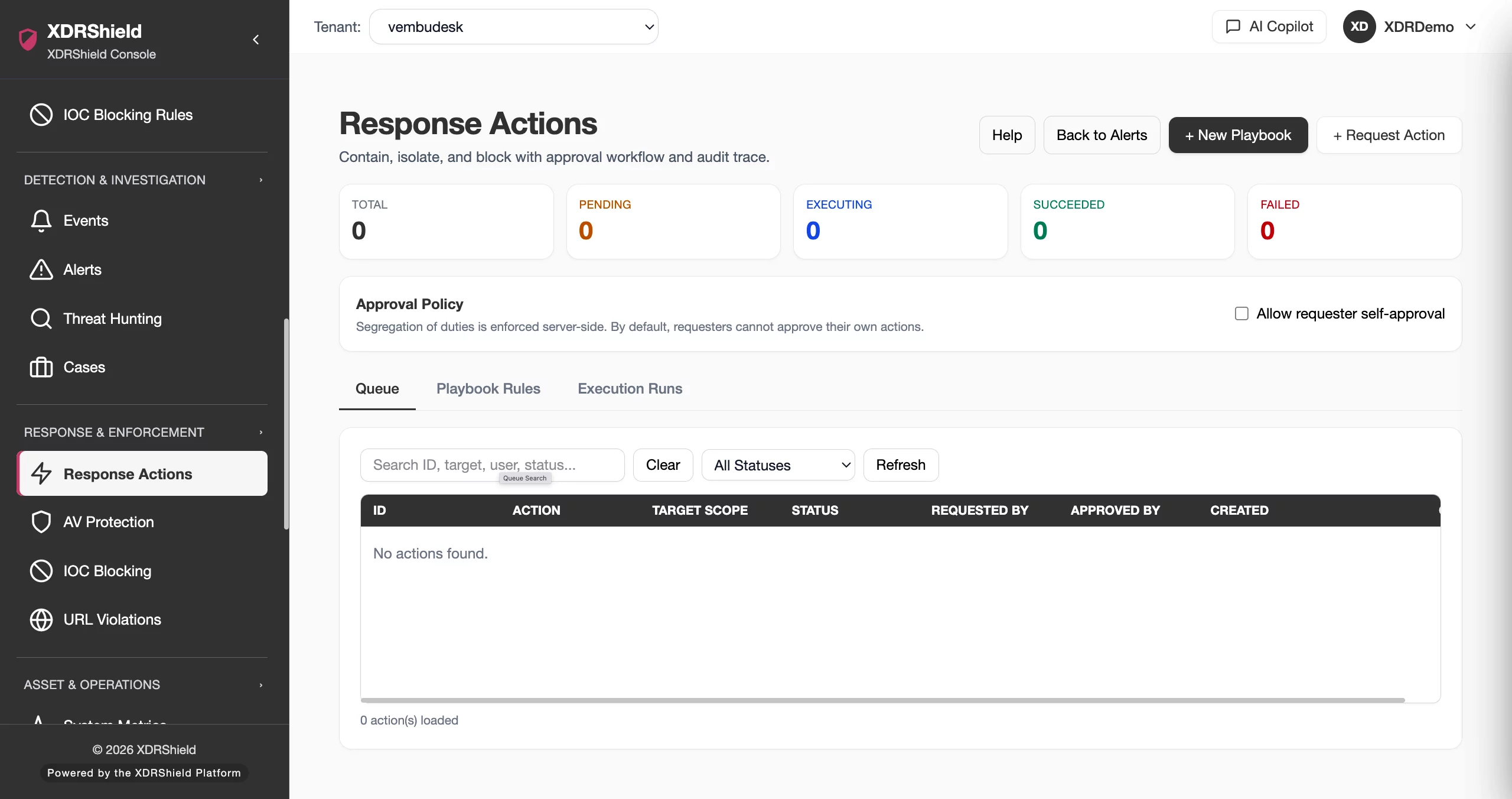
Use controlled response actions such as host isolation, process termination, file quarantine, and deletion with approval workflows and automated playbooks.
Endpoint Visibility
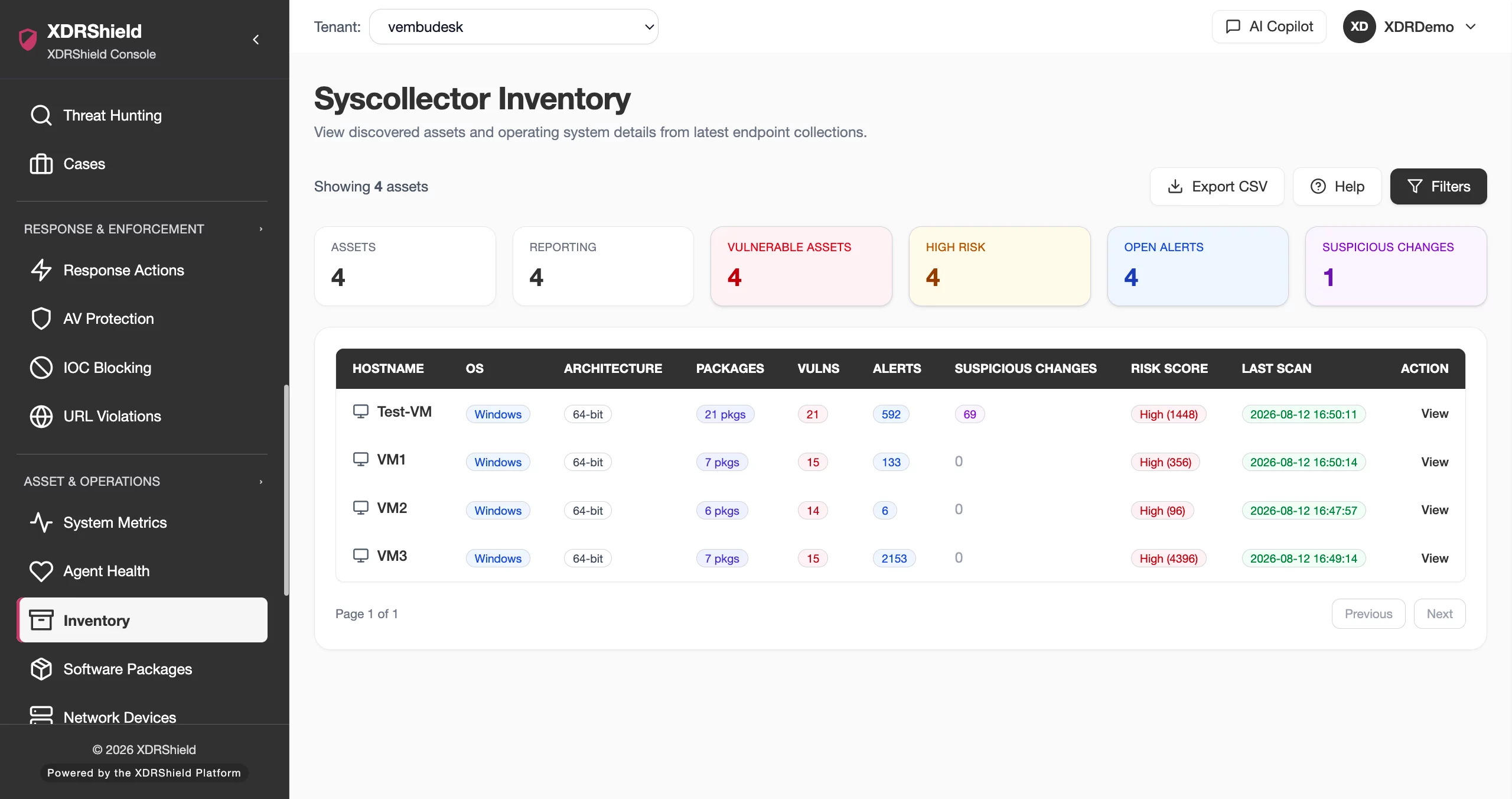
Maintain awareness of installed software, vulnerabilities, running processes, asset metadata, and endpoint behavior so problems can be understood earlier.
Security Operations
Support multi-tenant architectures, user management, notification routing, scheduled jobs, and repeatable workflows for teams managing at scale.
Accountability and Trust
Enforce role-based access control, tenant isolation, and comprehensive activity logging from login to response action so every event is recorded and reviewable.
Why security teams choose XDRShield for governed response.
XDRShield is built around how security operations actually work: detecting meaningful activity, investigating with context, and responding with control.
Detect threats without operational noise
Customizable detection rules and event correlation help surface threats that matter instead of overwhelming teams with unqualified alerts.
- Behavioral detection across files, processes, registry, and metrics
- Alert prioritization based on operational risk
- Real-time ingestion from monitored endpoints
Investigate with case-based evidence
When an alert fires, XDRShield turns the activity into a case with context your team can act on together.
- Automatic alert-to-case conversion
- Correlated evidence across endpoints and alerts
- Analyst notes, tags, disposition, and activity trail
Respond with governed action
Response actions are not taken blindly. Approval workflows and playbooks keep speed and accountability connected.
- Response library including isolate, terminate, quarantine, and delete
- Approval workflow support for sensitive actions
- Actions recorded against each case for accountability
The XDRShield protection cycle for continuity.
Resilience is a disciplined cycle. XDRShield connects prevention context, detection signals, response control, recovery evidence, and continuous improvement so security work remains visible and accountable.
Prevent
Use endpoint visibility, policies, and vulnerability awareness to reduce avoidable exposure.
Detect
Monitor file, process, registry, network, and system behavior so suspicious activity becomes visible.
Respond
Turn alerts into cases, assign ownership, and run response actions through controlled workflows.
Recover
Track action history and evidence so teams can restore confidence and return operations to normal.
Improve
Use activity records, case outcomes, and playbook feedback to strengthen readiness for the next event.
More than detection. Built for operational resilience.
XDRShield gives teams a practical path: collect endpoint telemetry, identify risky behavior, open a case, approve the right response, and keep a complete record of every action.
with clear evidence
Operational security capabilities for resilient endpoints.
Each capability is shaped around a resilience outcome: better visibility, faster investigation, safer response, and stronger operational proof.
Real-time endpoint monitoring
Track important endpoint activity in real time across files, processes, registry, network, and system behavior.
Customizable detection rules
Adapt detection logic to your environment, risk priorities, and service model.
Structured case management
Convert alerts into structured cases with ownership, timelines, notes, and linked evidence.
Approval-gated response actions
Run endpoint response steps with approval gates and role-based controls.
Automated XDR playbooks
Standardize repeatable workflows so analysts do not start from scratch every time.
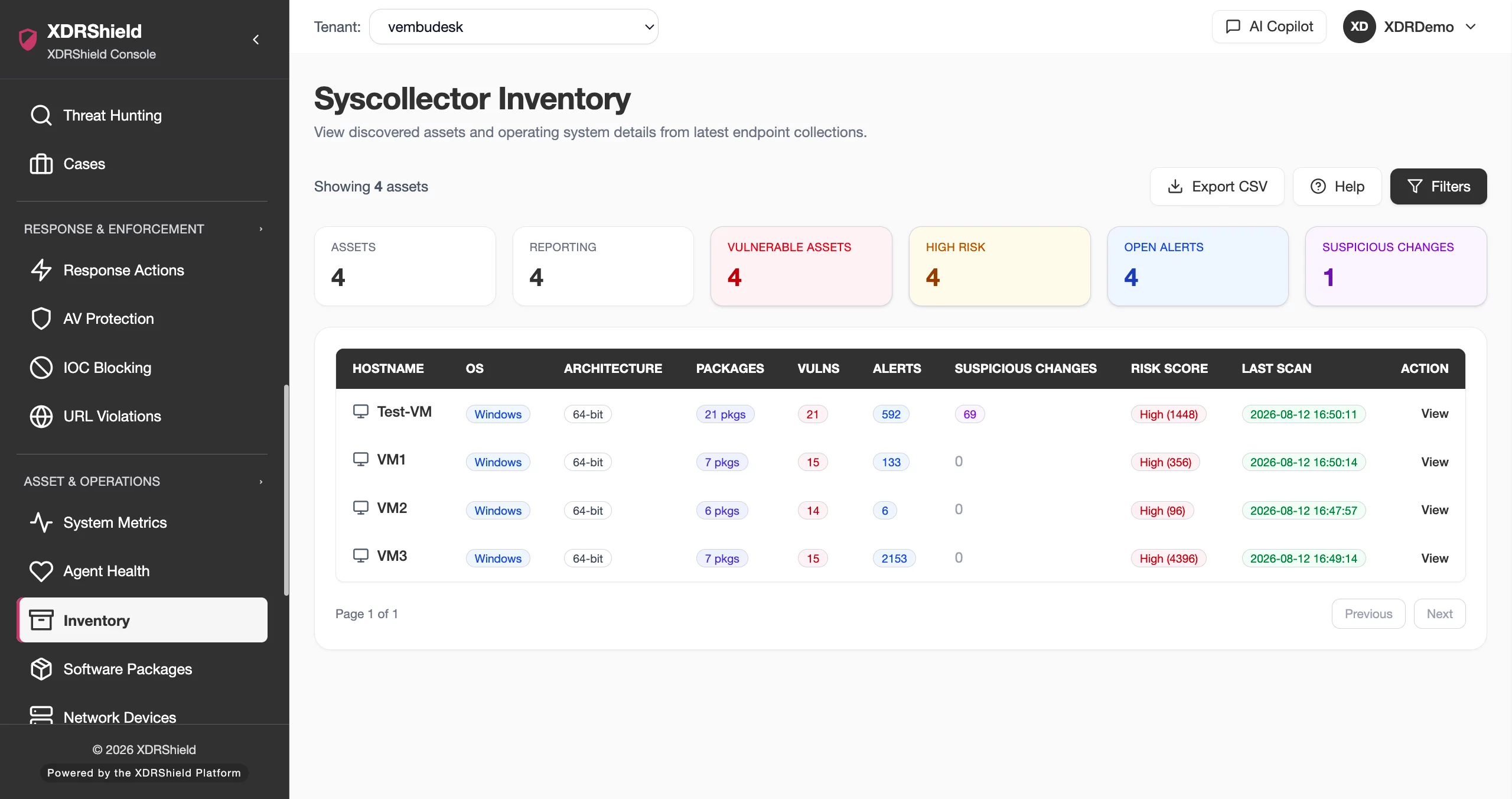
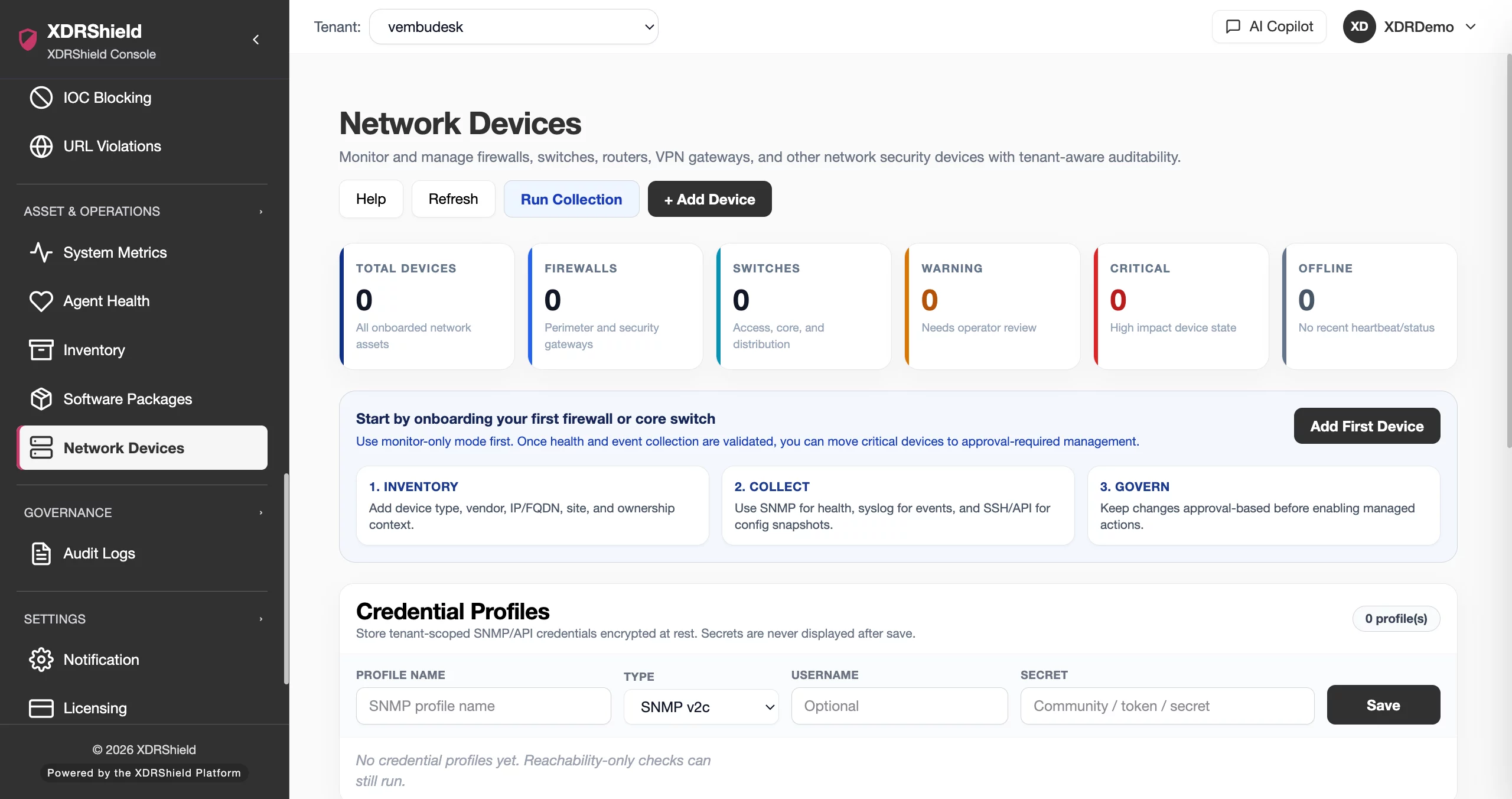
Asset inventory and visibility
Maintain clearer awareness of endpoints, exposure, and operational coverage.
Vulnerability management context
Bring vulnerability data into operational decisions and readiness planning.
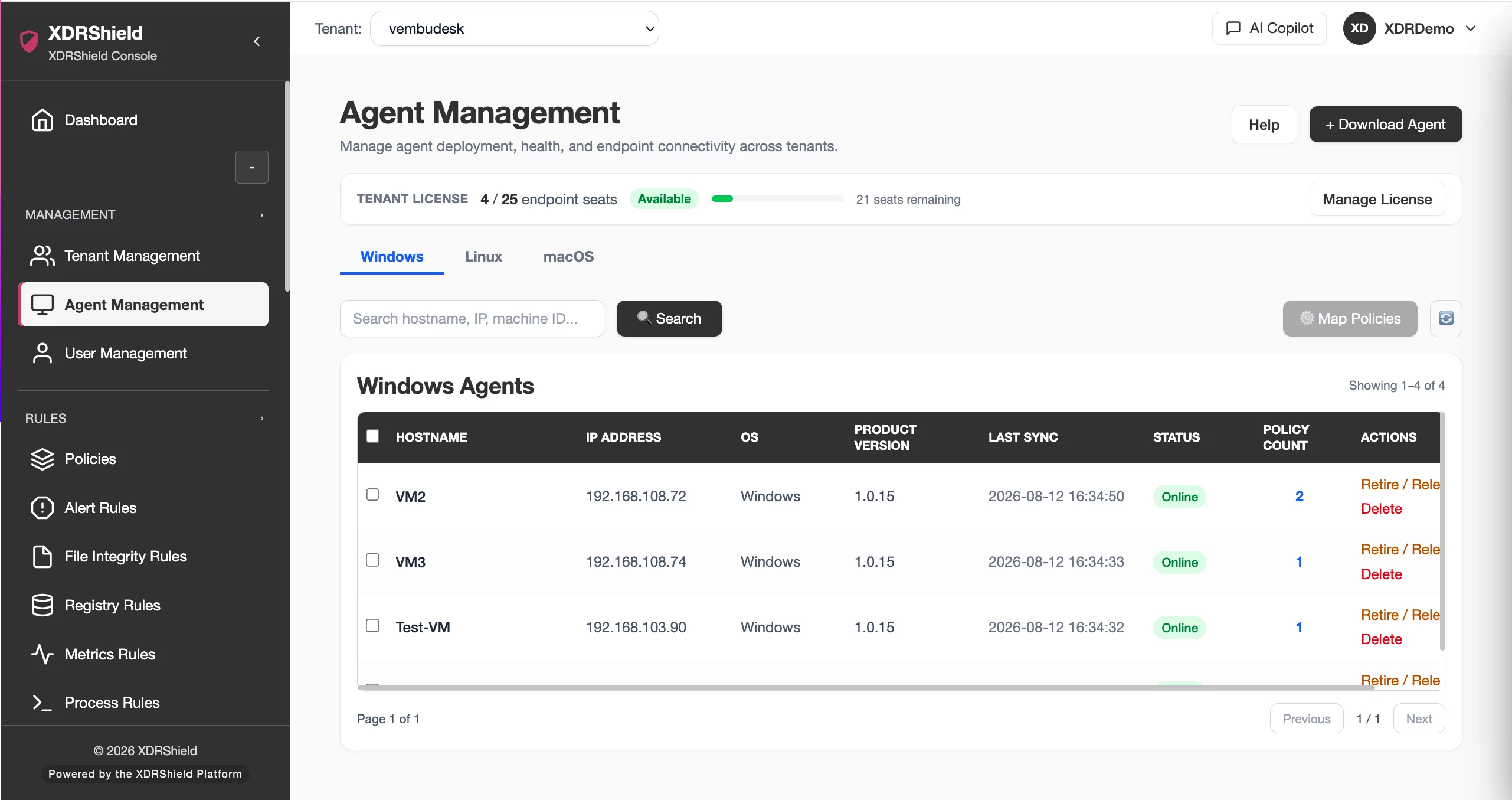
Multi-tenant MSP operations
Support multi-tenant security operations with centralized oversight for managed environments.
Role-based access control
Give the right people the right level of access for investigation and response work.
Comprehensive audit logging
Keep a clear record of every investigation step and response action.
Scheduled jobs and automation
Automate planned operational tasks and reduce manual follow-up.
Alert and notification routing
Direct the right signals to the right people so attention goes where it matters.
From deployment to accountable resolution in six steps.
The workflow is simple enough for lean teams and structured enough for managed security operations.
Deploy agents
Bring endpoints into view and begin collecting the telemetry your team needs.
Ingest and monitor endpoint events
Observe system activity across endpoints and tenants from a central console.
Trigger priority alerts
Use detection rules and alert routing to highlight activity that needs investigation.
Investigate with cases
Capture evidence, notes, ownership, and timeline context in one place.
Execute approved response actions
Run sensitive actions with RBAC and approval controls.
Audit, learn, and improve
Review what happened, document what changed, and strengthen readiness.
Where XDRShield protects business continuity.
XDRShield keeps the focus on practical preparedness and controlled action across common security operations priorities.
Ransomware response readiness
Surface suspicious behavior, organize evidence, and guide response actions before uncertainty spreads.
Client trust for managed security providers
Show customers that their environments are monitored, managed, and handled through repeatable processes.
Compliance and review pressure
Maintain activity records and action history that support team review and accountability.
Endpoint visibility gaps
Reduce blind spots across distributed systems, users, and managed tenant environments.
Faster security investigations
Bring alert context, case notes, and endpoint evidence into one investigation path.
Operational continuity under attack
Help teams respond with structure so business can keep moving while issues are handled.
Complete EDR and SOC coverage in one platform.
XDRShield connects endpoint detection and response with SOC-ready operations, so teams can protect endpoints, investigate alerts, execute controlled actions, and keep every decision review-ready.
| Platform layer | Extended Detection and Response (XDR) | Security Operations (SOC) |
|---|---|---|
| Threat detection | Real-time Behavioral MonitoringDetection rules across files, processes, registry, and network activity on individual endpoints. | Cross-Endpoint Threat CorrelationCorrelate alerts and events across multiple endpoints to identify coordinated attacks and lateral movement. |
| Investigation | Endpoint-Level Case AnalysisStructured cases with event timelines, analyst notes, and evidence tracking per endpoint. | Unified Investigation CasesSingle-pane investigation cases aggregate alerts, evidence, and response history across multiple endpoints. |
| Response | Direct Endpoint ActionsIsolate hosts, terminate processes, quarantine files, and remove threats from individual endpoints. | Automated XDR PlaybooksPre-configured playbooks execute multi-step response workflows across the environment for confirmed threat patterns. |
| Management | Centralized Endpoint ConsoleManage monitored endpoints with unified policy management, alert visibility, and endpoint activity context. | Multi-Tenant Management ConsoleManage client or business unit environments from one secure platform with tenant isolation and policy control. |
| Compliance | Endpoint Audit LoggingComplete records of endpoint events and analyst actions for compliance review and forensic analysis. | Compliance and Audit ReportingAudit-ready reporting for platform activity, investigation decisions, and response actions. |
| Best fit | Endpoint-Focused TeamsIdeal for organizations needing deep endpoint visibility and direct response capability. | Full SOC OperationsIdeal for MSPs and security operations centers managing complex, multi-client environments at scale. |
Endpoint protection and SOC capabilities that keep operations ready.
Windows Endpoint Protection
Real-time behavioral monitoring and response for Windows endpoints, including files, processes, registry activity, and network behavior.
Cross-Endpoint Threat Correlation
Connect alerts and events across endpoints to identify coordinated attacks and lateral movement before they spread.
Unified Investigation Cases
Aggregate alerts, evidence, timelines, notes, and response history in one case workflow for faster investigation.
Automated XDR Playbooks
Run pre-configured or configurable playbooks for common attack patterns while keeping human approval where needed.
Multi-Tenant Management Console
Manage client or business unit environments from one secure console with tenant isolation and policy control.
Analyst Workflow and Case Management
Guide analysts from alert triage through investigation, response, and closure with documentation tied to each decision.
Compliance and Audit Reporting
Maintain audit-ready records of platform activity, investigation decisions, and response actions for review.
EDR and XDR answers for resilience-focused buyers.
What is EDR in cybersecurity?
EDR, or Endpoint Detection and Response, continuously monitors endpoint devices such as laptops, desktops, and servers to detect and respond to threats in real time. EDR tools collect behavioral telemetry, apply detection rules, and support investigation and response actions.
What is XDR and how does it differ from EDR?
XDR, or Extended Detection and Response, extends EDR by correlating signals across multiple security layers. EDR gives deep endpoint visibility; XDR helps connect endpoint activity with broader operational context for faster decisions.
What is XDRShield and who is it designed for?
XDRShield is a unified EDR and XDR security platform for MSPs, IT security teams, SOC teams, and SMB environments that need threat detection, structured investigation, controlled response, and multi-tenant operations.
How does XDRShield detect threats?
XDRShield agents collect endpoint telemetry across files, processes, registry activity, network activity, and system metrics. Detection rules evaluate that activity and create alerts with the context analysts need to investigate.
Does XDRShield support multi-tenant environments for MSPs?
Yes. XDRShield supports multi-tenant security operations so MSPs can manage multiple client environments from one console while keeping tenant policies, alerts, cases, access, and logs separated.
What response actions can XDRShield execute?
XDRShield supports controlled endpoint response actions including host isolation, process termination, file quarantine, and file deletion. Actions can be manual, approval-gated, or automated through configured playbooks.
What is the difference between EDR and XDR software?
EDR focuses on monitoring and responding at the endpoint level. XDR broadens the workflow by correlating signals and investigation context across security domains, helping teams move from endpoint evidence to operational response.
How does XDRShield support compliance and review requirements?
XDRShield keeps activity logs of platform activity, detection changes, investigation work, and response actions. Logs are timestamped, attributable, and useful for review, accountability, and compliance-supporting evidence.
Can XDRShield work alongside existing security tools?
Yes. XDRShield is designed to strengthen endpoint detection, investigation, and response alongside the rest of your security stack, including SIEM, ticketing, and other operational tools where appropriate.
How long does it take to deploy XDRShield?
Teams can begin by deploying agents, collecting telemetry, reviewing alerts, and using case workflows. MSPs can then standardize tenant onboarding, policies, playbooks, and reporting as operations mature.
What operating systems does XDRShield support?
XDRShield is positioned around Windows endpoint protection, with endpoint coverage and platform support expected to follow the product’s current release scope and roadmap. Confirm exact OS support during evaluation.
What makes XDRShield different from other EDR solutions?
XDRShield is built around the complete operations workflow: detection engineering, real-time alerting, case management, analyst collaboration, approval-gated response, automation, multi-tenant management, and review-ready records.
Ready to see XDRShield in action?
See how XDRShield helps your team protect endpoints, investigate with structure, respond with control, and keep improving after every event.